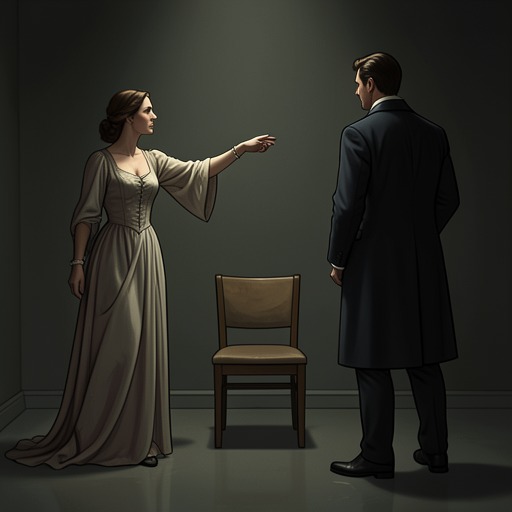
Patrick Bateman–Evelyn Richards relationship
American PsychoThe Patrick Bateman–Evelyn Richards relationship is presented as an intimate bond sustained less by mutual feeling than by status, ritual, appearance, and habit. Evelyn Richards treats Patrick Bateman as a prospective husband and seeks a firm commitment, while Patrick Bateman remains distracted by other women, competitive fantasies, consumer pleasures, and increasingly explicit thoughts of violence. Their eventual breakup is not a release into emotional truth: it becomes another scene in which Patrick performs composure while his narration fractures into cruelty, absurdity, and disconnection.
Identity and Social Setting
The relationship belongs to the tightly managed social world of Manhattan finance, expensive restaurants, designer clothing, private apartments, and carefully rehearsed manners. At a dinner gathering, Patrick Bateman and Timothy Price arrive at Evelyn Richards's brownstone, where Courtney Lawrence receives their coats and air-kisses them with identical precision. Evelyn Richards is in the kitchen arranging sushi on a Wilton stainless-steel platter and attempting to spell Patrick Bateman's initials, though she may instead use Timothy Price's initials when she runs short of yellowtail. The gesture looks romantic, but the scene immediately places romance inside a competitive social tableau involving Patrick Bateman, Timothy Price, Courtney Lawrence, and Luis Carruthers.
The same gathering also reveals how little privacy or exclusivity the relationship possesses. Courtney Lawrence is explicitly identified as Luis Carruthers's girlfriend, yet Patrick Bateman is involved with her as well, and rumors about that liaison have placed Courtney Lawrence on Evelyn Richards's list of disliked women. Patrick Bateman therefore occupies the position of Evelyn Richards's intended partner while simultaneously pursuing a relationship that threatens the very arrangement Evelyn Richards is trying to secure. His jealousy toward Courtney Lawrence and his willingness to deceive Evelyn Richards coexist without producing remorse or a clear decision.
Intimacy, Rivalry, and Possession
Patrick Bateman's connection with Evelyn Richards is repeatedly filtered through comparison. After escorting another man from the brownstone, Patrick Bateman pours himself brandy, returns to the bedroom, and asks Evelyn Richards why she does not simply choose Timothy Price. Her response, delivered with her eyes shut, makes Patrick Bateman think that she may have had sex with Timothy Price. The exchange turns intimacy into a contest over access, desirability, and possession rather than a conversation between partners.
The relationship's emotional vocabulary is similarly unstable. Patrick Bateman can describe jealousy, but the feeling quickly becomes an instrument of self-scrutiny and sexual calculation. He wonders whether Courtney Lawrence would spend more time with him if Luis Carruthers were dead, whether Courtney Lawrence is attracted to his body rather than his personality, and whether killing Luis Carruthers would make his own world safer. He then abruptly considers marrying Evelyn Richards and imagines the financial burden of buying her Lacroix gowns until their divorce is finalized. Evelyn Richards and Courtney Lawrence are thus not held apart as distinct emotional relationships; they are placed on the same internal ledger, where sex, marriage, clothing, rivalry, and violence become interchangeable forms of valuation.
The most extreme consequence of this possessive logic is Patrick Bateman's attack on Luis Carruthers in a deserted men's room. Patrick Bateman approaches Luis Carruthers while he is urinating and begins tightening his hands around Luis Carruthers's neck. The assault is connected in Patrick Bateman's mind to Courtney Lawrence, but Evelyn Richards's presence in the same chain of thoughts is crucial: marriage to Evelyn Richards appears beside the question of whether Luis Carruthers should be strangled. The relationship therefore functions not as a stabilizing alternative to Patrick Bateman's violence but as one of the social circumstances through which his violence is imagined.
The Dinner That Breaks the Arrangement
The relationship reaches its clearest crisis during a dinner at Barcadia. Patrick Bateman has spent the afternoon buying himself early Christmas presents, including large scissors, a letter opener, and a cheese knife. He arrives in an elaborate Gianni Versace outfit, while Evelyn Richards wears an Anne Klein jacket, a wool-crepe skirt, a silk blouse from Bonwit's, and antique gold and agate earrings costing roughly four thousand dollars. The detailed inventory of clothing and objects makes their date look like a catalog of status signals rather than a meeting organized around shared feeling.
Patrick Bateman has also failed to cancel another reservation and has not warned Courtney Lawrence that he will not meet her. He expects Courtney Lawrence to arrive at Turtles confused and possibly furious, and he laughs aloud at the prospect while Evelyn Richards orders Cristal with cassis and attempts to add blueberry syrup to his glass. His amusement at Courtney Lawrence's probable distress turns the dinner with Evelyn Richards into a stage for an unseen humiliation. Even when Patrick Bateman is physically present with Evelyn Richards, his attention is directed toward manipulating people who are elsewhere.
The dinner deteriorates further when Evelyn Richards eats a contaminated urinal cake. Patrick Bateman is first fascinated by the spectacle and then feels that the experience has become futile, an anticlimax that leaves him enduring her company for no satisfying reason. His reaction is characteristic of the relationship: fascination, disgust, and boredom replace sympathy, yet none of those responses leads to honest withdrawal until Evelyn Richards demands something concrete. When she says, "I want a firm commitment," the demand names the condition that has been implicit throughout their association. Evelyn Richards wants the relationship converted into a stable public future; Patrick Bateman experiences that request as suffocating and unreasonable.
Patrick Bateman first says that they have lost touch and then states plainly, "It's over, Evelyn. It's all over." When Evelyn Richards treats the declaration as another touchy moment, he insists that the relationship is finished and that the matter is not a joke. The repetition gives the breakup an unusual directness, but the surrounding scene undermines its emotional authenticity: the conversation is surrounded by consumption, bodily disgust, resentment, and Patrick Bateman's inability to remain mentally present.
Aftermath and Narrative Meaning
After the breakup, Patrick Bateman responds to Evelyn Richards's question about where he is going by saying, "Libya," then correcting himself to "Pago Pago." He also refuses to pay for the meal because of her outburst. The exchange converts the end of the relationship into a performance of arbitrary detachment. Rather than offering an explanation, Patrick Bateman produces geographical nonsense and a petty financial consequence, treating emotional accountability as another bill he can decline.
The aftermath is inseparable from the book's unreliable narration. Patrick Bateman's account moves from a restaurant conversation into images of bodily destruction, nuclear war, money, assassinations, and a world that repeatedly changes form like a sitcom or soap opera. He imagines Evelyn Richards's skeleton twisted and crumbling and experiences glee at the image, while also asking whether he is an actual automaton. The relationship's failure therefore reveals not a hidden capacity for ordinary grief but the depth of Patrick Bateman's depersonalization and emotional numbness.
The relationship also remains entangled with Patrick Bateman's wider crisis of identity. In the aftermath of a violent sequence that may be real, imagined, or deliberately distorted by his narration, Patrick Bateman reaches a new office, signs in with the night watchman Gus, and leaves Harold Carnes a message confessing to dozens or hundreds of murders. While police, ambulances, and a SWAT team gather around the building he has left, he says that he left a woman in a parking lot near a Dunkin' Donuts and finally describes himself as a sick man. Evelyn Richards is not simply the abandoned partner in this ending; she is part of the moral and perceptual world in which Patrick Bateman's private dementia becomes briefly public, though the confession itself cannot be treated as secure fact.
Thematic Significance
The Patrick Bateman–Evelyn Richards relationship dramatizes how romantic commitment can be absorbed into the same marketplace of appearances that governs Patrick Bateman's professional and social life. Clothes, restaurants, champagne, reservations, jewelry, and future divorce expenses provide the relationship's visible structure, while affection remains uncertain and violence presses beneath the polished surface. Evelyn Richards seeks recognition and commitment, but Patrick Bateman evaluates her through irritation, sexual comparison, financial calculation, and aesthetic judgment.
The relationship also demonstrates the failure of social performance to contain private disorder. Patrick Bateman can appear at dinner in a precise suit, manage reservations, display a new business card, and maintain the etiquette of air-kissing and expensive hospitality. Yet the performance repeatedly leaks: he laughs at another woman's anticipated distress, imagines strangling Luis Carruthers, becomes absorbed by Evelyn Richards's grotesque meal, and answers the breakup with nonsense. The bond ends without reconciliation, grand gesture, or stable emotional resolution. Its decisive significance lies in that refusal of the conventional romantic ending: commitment cannot humanize Patrick Bateman, and the collapse of the relationship exposes rather than repairs the emptiness beneath his immaculate public identity.